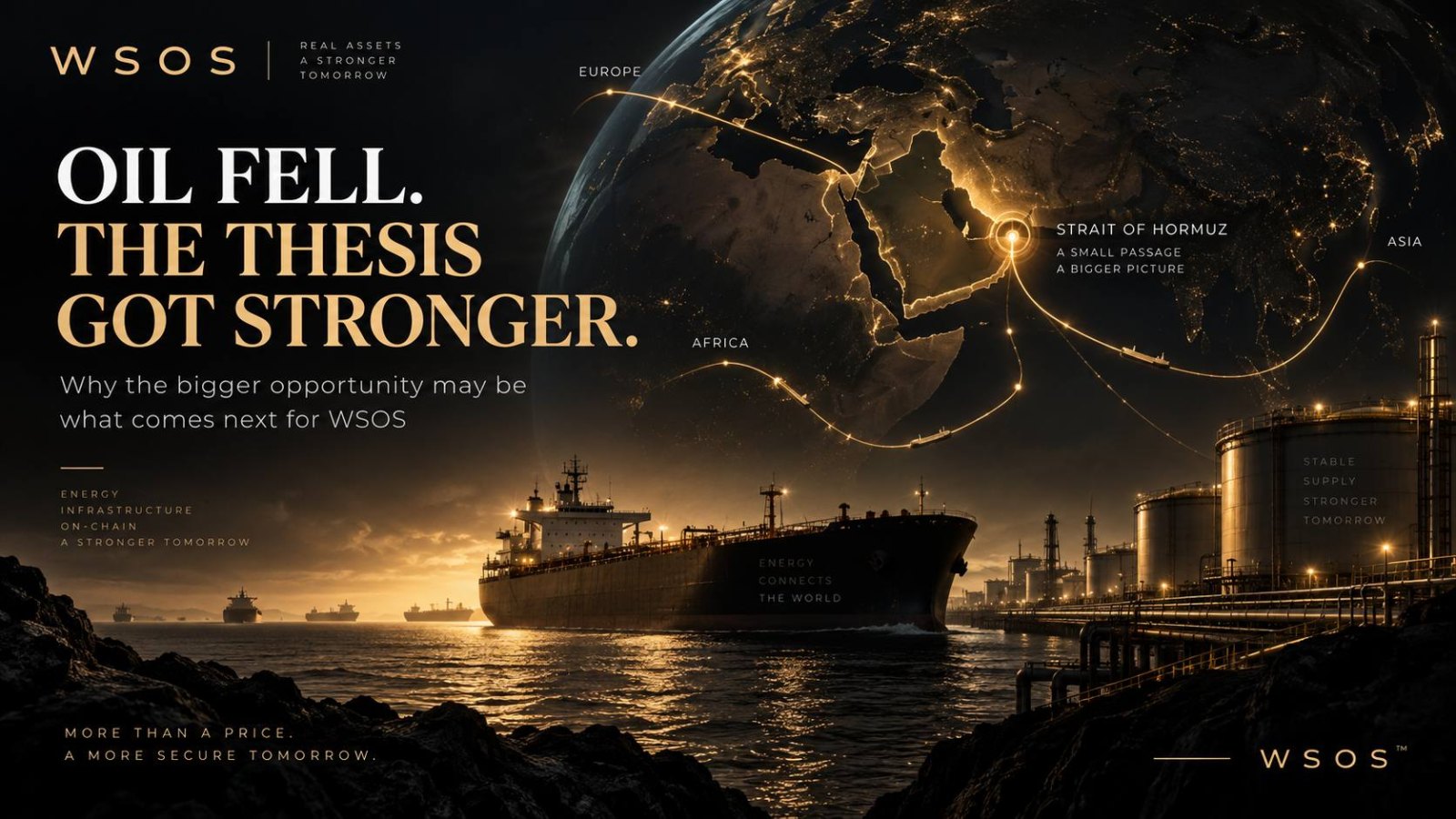
Oil Just Fell. But the Bigger Story Is Getting Closer. $WSOS TOKEN
Oil prices just pulled back as hopes of a reopening of the Strait of Hormuz eased immediate supply concerns. But while traders are watching crude prices, something else is getting closer. Join the $WSOS Token Now!
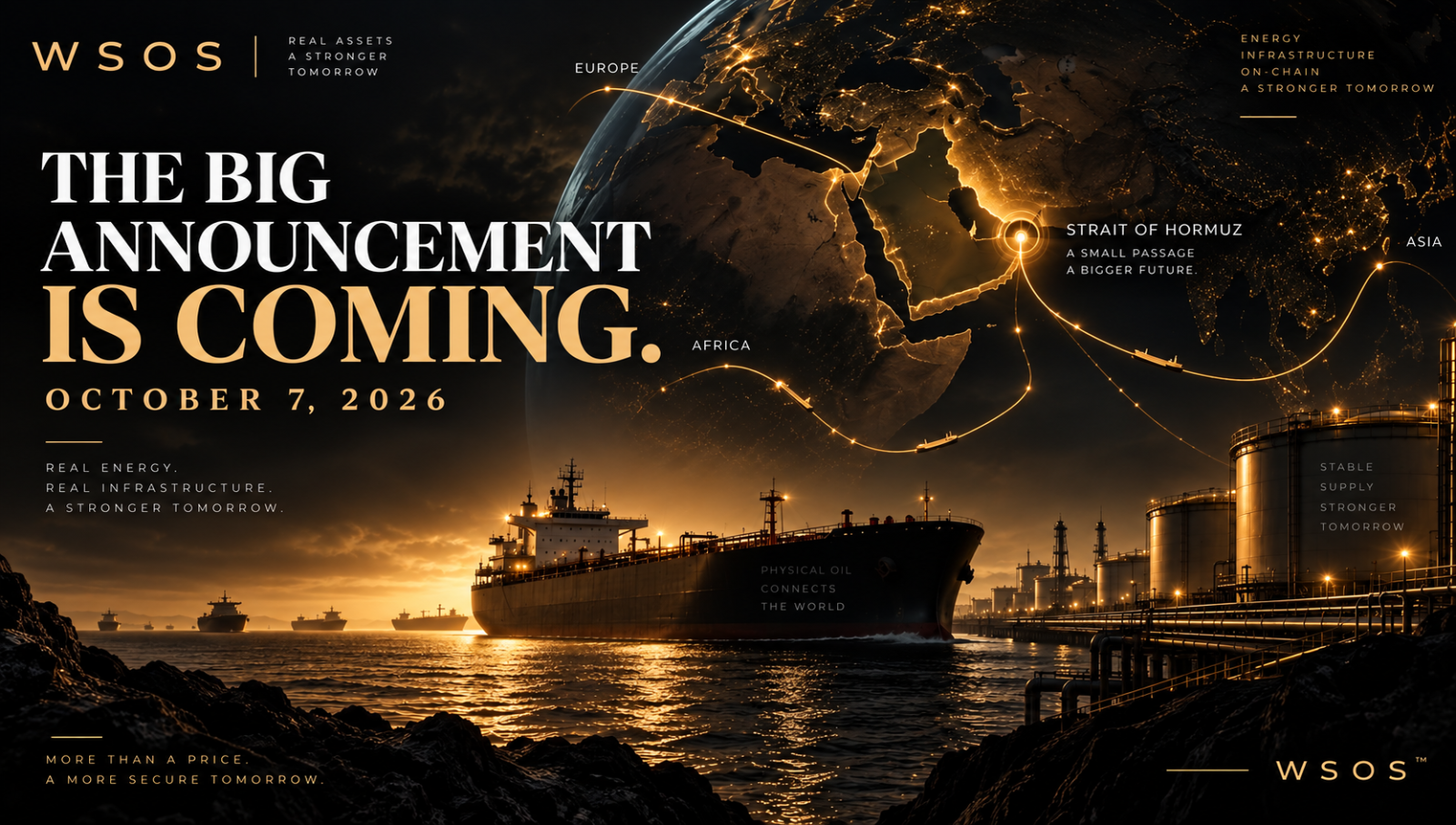
October 7 Is Approaching — And WSOS Is Getting Ready
Oil prices just pulled back as hopes of a reopening of the Strait of Hormuz eased immediate supply concerns.
But while traders are watching crude prices, something else is getting closer.
October 7.
The date WSOS has been building toward.
And with the announcement now only weeks away, the story around World Strategic Oil Supply is becoming increasingly difficult to ignore.
Oil just delivered another reminder of why the future of energy markets may be about far more than the price of a barrel.
On September 22, crude prices fell to a two-week low after Iran proposed reopening the Strait of Hormuz within seven days if the United States eased military pressure and lifted restrictions on Iranian ports. Saudi Arabia's restart of its East-West pipeline added further relief to the market.
At first glance, that might sound negative for an oil-focused project.
But the move actually highlights the core idea behind WSOS.
The market did not suddenly discover billions of barrels of new oil.
Expectations around access to existing oil changed.
One shipping route.
One diplomatic proposal.
One infrastructure decision.
And billions of dollars of market value can move almost instantly.
That is precisely where the WSOS thesis begins.
Oil is not simply about the price of a barrel.
It is about where the barrels are, who controls them, whether they can be transported, whether they can be refined, and whether the people who need them can actually access them.
And now, with October 7 getting closer, that thesis is moving toward its first major real-world test.
The Physical Oil Problem Isn't Going Away
The possibility of Hormuz reopening is obviously important.
Before the recent conflict, roughly one-fifth of global oil and gas supplies moved through the Strait of Hormuz.
But removing one disruption does not suddenly repair the entire global energy system.
Look at diesel.
Despite crude prices falling, global diesel markets remain exceptionally tight. Middle Eastern diesel exports have fallen sharply, U.S. diesel prices have reached record levels, and American diesel inventories are at their lowest September level since government records began in 1982.
Europe is facing pressure too.
Jet-fuel inventories have fallen significantly, and Europe is increasingly relying on supplies from much farther away to bridge the gap.
That is the key point:
A falling crude price does not automatically mean the physical energy problem has disappeared.
A barrel still has to move through an entire chain:
Produced → transported → refined → stored → distributed → delivered.
Break one part of that chain and scarcity can appear even when crude technically exists somewhere in the world.
America Has Less Emergency Oil Than It Used To
There is another major piece of the story.
Strategic reserves.
The U.S. Strategic Petroleum Reserve has fallen to levels not seen since 1982.
That matters because emergency reserves are effectively insurance against the next major disruption.
Governments can use them to temporarily replace missing supply while production, logistics or geopolitical conditions stabilize.
But the smaller the reserve becomes, the less capacity there is to absorb another major shock.
And that is exactly why the WSOS thesis does not depend on oil reaching $150, $200 or any other specific price.
Strategic supply has value because uncertainty exists.
The more fragile the physical system becomes, the more important reserves, access, custody, transportation and verification become.
And that brings us back to WSOS.
At The Same Time, Finance Is Moving On-Chain
While the physical oil market is dealing with supply constraints, another transformation is happening in financial markets.
Tokenization is accelerating.
Tokenized real-world assets reached record levels in August, while tokenized equities also reached an all-time high.
The numbers are still small compared with traditional financial markets.
But the direction is becoming increasingly difficult to ignore.
The European Central Bank has announced plans involving tokenized securities and infrastructure connecting blockchain-based markets with central-bank-money settlement.
Major technology companies are also recruiting specialists with experience in digital assets, stablecoins, tokenized deposits and blockchain infrastructure.
None of this means traditional finance is suddenly being replaced.
But it does reinforce a broader trend:
Traditional assets are gradually acquiring digital rails.
Cash.
Bonds.
Equities.
Deposits.
Real-world assets.
And WSOS is making a different proposition:
Why shouldn't energy eventually be part of that list?
October 7 Is Getting Closer
This is where the timeline becomes particularly interesting.
October 7 is no longer just another date on a roadmap.
It is getting closer.
WSOS currently lists October 7, 2026 at 15:00 UTC as the launch time for applications.
And as that date approaches, attention naturally shifts from the idea itself to what actually happens when the system goes live.
The proposed Genesis phase is designed around a relatively simple concept.
A user connects a blockchain wallet.
They register non-binding interest in a future physical-oil allocation.
That interest can be timestamped and associated with an on-chain identity.
Over time, the goal would be to create something unusual:
a digitally verifiable demand book for physical oil.
That does not mean that connecting a wallet suddenly gives someone ownership of barrels sitting inside a storage tank.
Physical-oil ownership requires legal agreements, compliant counterparties, custody arrangements, verification, settlement and clearly defined ownership rights.
That distinction matters.
October 7 is supposed to be the beginning of that infrastructure journey — not the claim that the entire system already exists.
And that makes the upcoming announcement particularly important.
What Comes After October 7?
Genesis is intended to be only Phase One.
The broader roadmap moves toward increasingly difficult pieces of infrastructure.
First:
On-chain demand.
Then:
Qualified physical-oil contracts.
Then:
Custody, verification, compliance, settlement and legally enforceable documentation.
And eventually, the major milestone:
WSOS OIL #0001
A real contract.
A defined underlying asset.
Verification.
Appropriate custody information.
Documentation.
A cryptographic record.
And a corresponding record on Solana.
If WSOS eventually reaches that stage, the project would be doing something substantially different from simply launching another crypto token.
It would be attempting to connect the blockchain economy with the physical energy economy.
Then Comes the Intelligence Layer
The roadmap does not stop with ownership.
WSOS also intends to develop an Oil Terminal designed to bring together information around the global physical oil system.
Potential datasets include:
Strategic reserves Refinery outages Shipping routes Tanker movements Freight costs Pipeline disruptions Oil and refined-product prices Global inventories Eventually, WSOS-linked physical contracts
That could create a broader use case than a token alone.
Oil-market information is currently spread across government agencies, commodity-data providers, shipping platforms, exchanges and individual market participants.
A platform combining strategic oil intelligence with verifiable on-chain assets would therefore target two different layers of the same industry:
Information.
And eventually:
Ownership.
The longer-term ambition is a marketplace containing multiple verified energy contracts.
Why The Current Valuation Gets Attention
This is where the speculative side of the story becomes particularly interesting.
CoinGecko data on September 22 put WSOS's market capitalization at approximately $1.9 million, with roughly $108,000 in reported daily trading volume.
That is extremely small relative to the size of the industries WSOS is attempting to build around.
Of course, a small market capitalization does not mean an asset must become a large one.
Early-stage crypto projects face substantial execution, liquidity, regulatory and technological risks.
But the underlying contrast is clear.
WSOS is positioning itself around two enormous themes:
Strategic energy infrastructure
and
Real-world asset tokenization.
One is being pushed into the spotlight by geopolitical disruptions, refinery problems, transportation constraints and depleted reserves.
The other is being accelerated by institutional participation and the development of blockchain-based financial infrastructure.
And WSOS remains valued at less than $2 million.
That is why the project is attracting attention from traders looking specifically at the intersection of oil + tokenization + blockchain infrastructure.
October 7 Is The Date To Watch
Perhaps the most important takeaway from today's oil move is that WSOS does not necessarily need crude prices to rise every single day for its broader thesis to remain relevant.
Oil fell because expectations around physical access changed.
Tomorrow, another event could move those expectations again.
That volatility is precisely what demonstrates the importance of the underlying infrastructure.
Who owns the barrel?
Where is it?
Who can refine it?
Which route can transport it?
Can it reach the customer?
How much strategic inventory remains?
Those questions exist at $90 oil.
They exist at $120 oil.
And they will still exist if Hormuz eventually returns to normal.
The opportunity WSOS is targeting therefore sits one layer beneath the commodity price itself.
It is attempting to build around the infrastructure of strategic supply.
And now, the next major date is getting closer.
October 7.
The announcement.
The launch.
The first meaningful test of whether the idea can begin moving from concept toward infrastructure.
The countdown is on.
Physical oil. Digital ownership. On-chain infrastructure.
October 7 is getting closer.
Get $WSOS
World Strategic Oil Supply is live on Solana. Applications go live on October 7, 2026.